The First Time Is the Hardest. Here's What It Actually Looks Like.
Not a tutorial. An honest account of what happens when an organization goes live for the first time — and what comes back after.
The event is about to start.
You've been thinking about doing this for a while. You told yourself you'd figure it out eventually. You mentioned it at a board meeting once. You've seen other organizations do it and meant to ask how. And now here you are — phone in hand, ten minutes before things get underway — wondering if today is actually the day you try it.
This is the story of what happens next.
Sixty seconds before you're live.
You open a browser on your phone. Navigate to switchernow.com. Sign in.
The screen shows a simple control panel. There are not many options, which turns out to be a relief. You tap the button to go live. A camera view appears — whatever your phone is pointed at. You adjust the angle. It looks right.
You tap Start Stream.
You are live.
That took about sixty seconds. It did not require anything you didn't already have. It did not require a tech person. It did not require preparation, equipment, or any knowledge you needed to look up beforehand.
The next thing you do.
You copy the watch link and paste it into the message thread where families have been asking about today. You hit send.
That is the entire distribution strategy. A link and a message thread. The families who've been asking if there's a way to watch are now watching.
Three of them respond within two minutes. One sends a screenshot of the stream from their living room. One asks if there's a way to see a different angle.
You type back: if you're here at the event, scan the QR code on the control panel and you can add your phone as a camera.
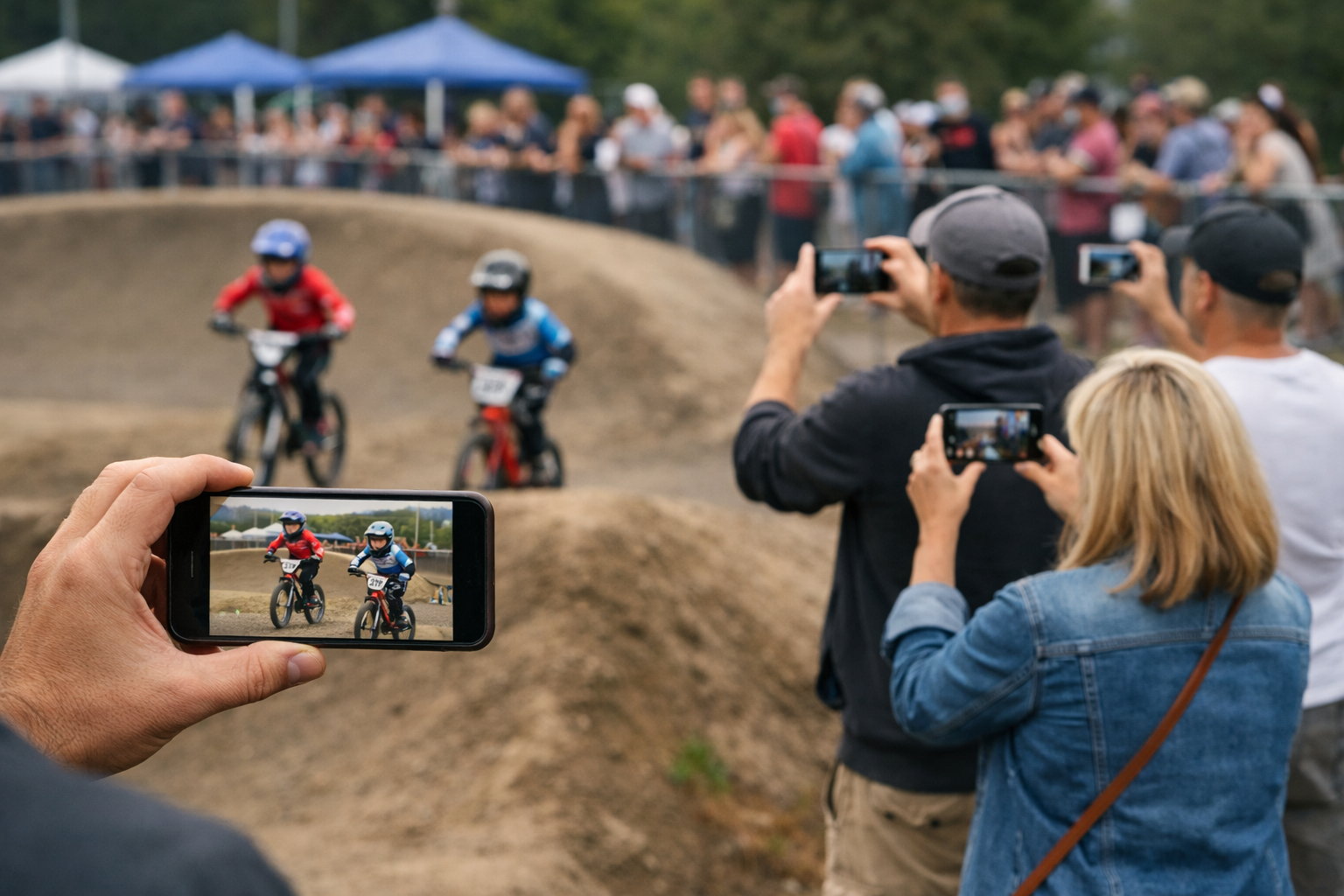
A parent at the sideline scans in. Families watching at home now have two angles to choose from. This was not coordinated in advance. It required no planning. It just happened because someone was there and had a phone.
The event happens.
You don't manage the stream. You run the event — the same way you always have.
Someone walks in front of the camera. The families watching from home see that and switch to the other angle. The cellular signal drops on one phone for thirty seconds. Nobody notices. The other phone keeps going.
At some point in the middle of it all, you forget the stream is running.
What comes back after.
The messages arrive before the event is even over.
"We saw the whole thing. She hasn't been able to travel in two years."
"Dad watched from Phoenix. First time he's seen it live in months."
"I shared the link with the whole family group. Everyone watched together from different cities."
This is the part nobody warns you about. The feedback isn't about the product. It's about what the product made possible. Nobody comments on the stream quality or the camera angle. They talk about the people on the other end of the link — the family members who got to remotely attend something they would otherwise have missed entirely.
The first time you see this, it reframes the whole thing. You weren't adding a feature to your events. You were opening a window for people who had been on the outside looking in.
Why the first time is the hardest.
Not technically. Technically it's sixty seconds and a link. The first time is the hardest because you don't know yet what's going to come back.
Once you know — once you've seen the messages and understood what you gave to the people watching from home — the second stream is easy. The third one is automatic. Eventually it becomes part of how your events work. Not a project you're getting to eventually. Just something you do.
The only one that requires any thought is the first one.
Your next event is the test. One stream. One link. See what comes back.
Try Switcher Now free at switchernow.com. No equipment, no commitment. What's your next event?